The WordPress threat landscape changed drastically in 2026, and we expect the pace to continue in 2027. Security researchers are using AI coding agents to find vulnerabilities faster. So are attackers.
In response, we built our own AI research systems, Wordfence PRISM and Wordfence Argus, which are credited with more than 500 published vulnerability discoveries, and invested heavily in the models, analysts and processes that turn those discoveries into protection for over 5 million WordPress sites.
Below, we share the details of that work and how we’re investing in staying ahead of threats in 2027.
How the WordPress Threat Landscape Changed in 2026
This year brought the first critical unauthenticated remote code execution vulnerability in WordPress core in nearly a decade and two critical vulnerabilities in PHP, the language WordPress runs on.
AI coding agents have developed rapidly over the past year, and they quickly surpassed what was humanly capable in vulnerability research. Finding and exploiting vulnerabilities in code used to take years of expertise and significant effort to understand and carry out. Now researchers increasingly do that work with AI coding tools and agentic security testing harnesses.
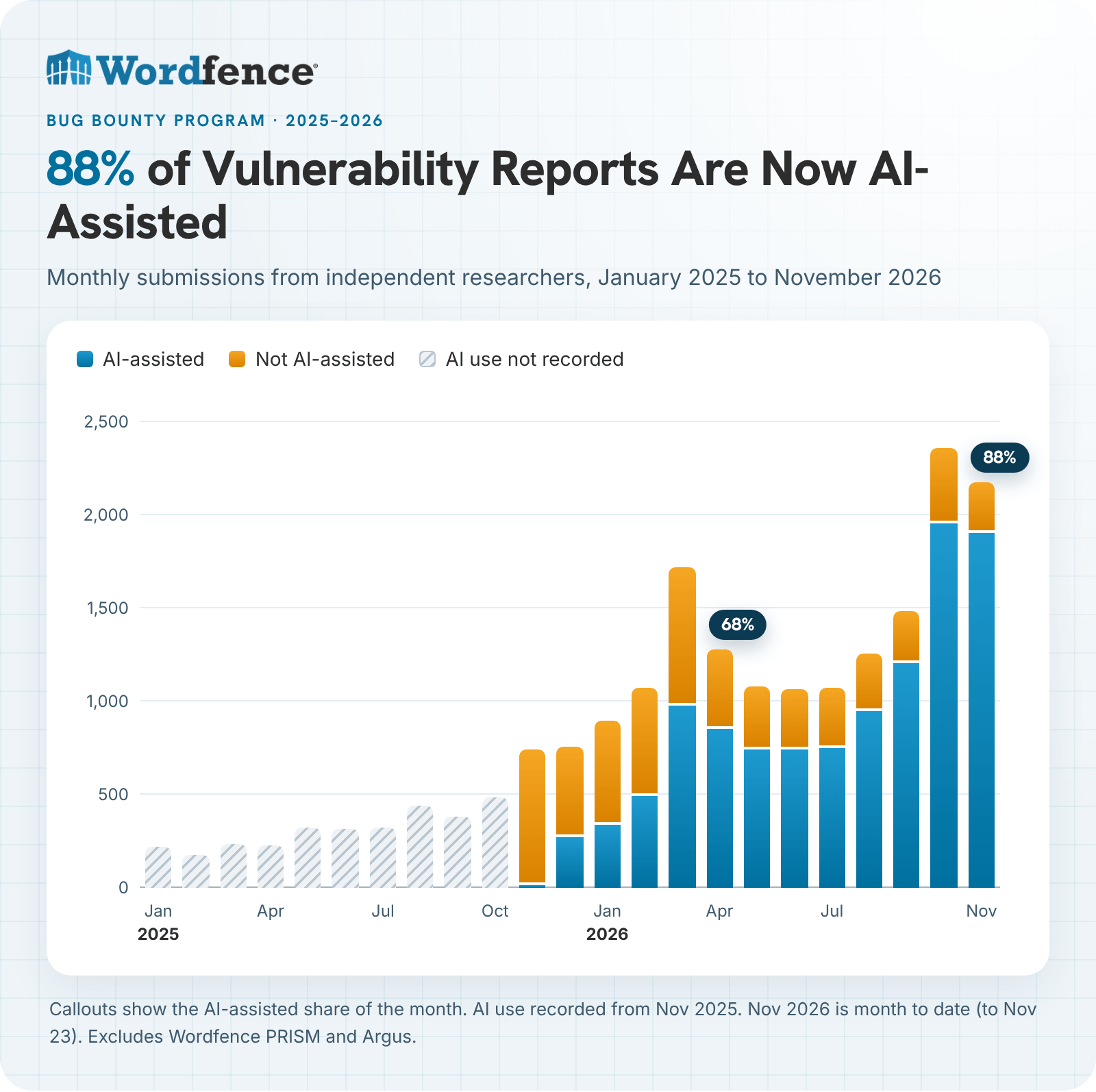
In April, we reported that AI-assisted reports had grown from 16% to roughly 66% of submissions to our Bug Bounty Program. So far in November, 88% of the reports independent researchers have submitted to the program are AI-assisted.
The same tools are available to attackers, and they are already using them. Google’s Threat Intelligence Group recently described an attacker framework that monitors popular web software for security patches, compares the code before and after each fix to find the vulnerability, writes an exploit and runs it without any human involvement.
One of the examples Google published shows the framework analyzing a WordPress plugin. Tools like this shorten the time between a patch being released and attackers exploiting it, so how quickly protection reaches a site matters more than it used to.
At Wordfence, our mission is to secure the web. In 2026, that meant building our own AI research tools and investing heavily in the most capable security research models we could access, including some that are not publicly available and are offered only to approved security teams.
Finding Vulnerabilities Before Attackers Do
Wordfence PRISM, our AI vulnerability research system, is credited with 504 published vulnerability discoveries as of November 23, 296 of them in the last 90 days. In the past 30 days alone it was credited with 149 findings, across more than 100 different plugins and themes.
Wordfence Argus, our autonomous research agent, is credited with 17 published discoveries since late August, 16 of them rated High or Critical. They include a six-step critical remote code execution chain in the Avada theme, two unauthenticated remote code execution chains in The Events Calendar, and an unauthenticated file upload vulnerability in Gravity Forms. Argus also found critical vulnerabilities beyond WordPress, in libheif and Ghostscript, system software that many servers, media tools and document pipelines rely on to process images and PDFs.
Every vulnerability our AI systems report is reviewed by a Wordfence analyst before it is published or sent to a vendor.
Our own research runs alongside the work of independent researchers in our Bug Bounty Program, which has paid more than $1 million in bounties since it launched, including more than $436,000 awarded so far this year, up from $259,000 in all of 2025. The work of independent researchers remains essential, because the more people and tools looking at WordPress software, the fewer vulnerabilities are left for attackers to find first.
Turning Discoveries Into Protection
More reports also mean more to sort through. Of the more than 16,700 reports submitted to us in 2026, about 4,400 were confirmed as valid vulnerabilities, and most of the rest were duplicates or did not hold up. To keep pace, our Threat Intelligence team uses a multi-agent AI pipeline that checks each submitted report against the real software before it reaches an analyst, so our analysts spend their time on confirmed vulnerabilities and valid reports reach vendors and our firewall team faster.
From there, we work with WordPress plugin and theme vendors to get vulnerabilities patched as soon as possible. More than 1,000 vendors have registered for our Vulnerability Management Portal, covering more than 5,000 plugins and themes. The portal streamlines disclosure, so vendors receive reports quickly and patches reach site owners sooner. In the meantime, we deploy firewall rules and malware signatures through the Wordfence plugin. Wordfence Premium, Care, and Response customers receive them in real time.
Real-time protection matters most for software that does not update on its own. Many premium plugins and themes are not distributed through WordPress.org and often do not update automatically, so a firewall rule can be the only thing protecting a site until its owner updates manually.
We also screen new plugin versions for malicious code, such as backdoors added through a compromised developer account. In July, PRISM detected a backdoored WordPress plugin less than two hours after the malicious code was introduced, and this month it flagged a supply chain compromise of six WP connect plugins, which WordPress.org’s release hold stopped before the backdoored versions reached any sites. Catching a malicious update early means it can be flagged before it spreads to the sites that install it.
We also publish the research for free on Wordfence Intelligence, along with a vulnerability data feed API and webhook notifications, which practitioners and larger security platforms rely on for threat data.
In October, we launched the Wordfence Threat Response Team to respond to rapidly emerging threats, providing protection for Wordfence users and clear guidance for site owners. Two days later, the team deployed a firewall rule about three hours after WordPress 7.1.4 fixed a remote code execution vulnerability in core. Since then, we have also traced the scanner behind November’s rise in attacks on Taiwanese websites and published guidance on critical HTTP/2 vulnerabilities in Apache and NGINX, web servers that host WordPress sites.
Investing in Our Mission to Secure the Web in 2027
We are honored to protect more than 5 million websites every day. Running frontier AI models at this scale, alongside the analysts who review our research and work with vendors, is a significant and growing investment. In order to support that work at the level today’s threats require, pricing for Wordfence Premium, Care, and Response will increase on Thursday, December 3.
We will keep investing in and evolving the teams, tools, and technology behind the protection our products and services provide to stay ahead of the threats in 2027. Each paid plan includes the following, and the full comparison is on our pricing page.
Wordfence Premium

Includes:
- ✓Real-time firewall rules and malware signatures
- ✓Real-time IP blocklist
- ✓Country blocking
- ✓Ticket-based Premium support
Wordfence Care

Everything in Premium, plus:
- ✓Our team installs, configures and optimizes Wordfence for you
- ✓Ongoing monitoring of your site security
- ✓A yearly security audit with recommendations
- ✓Unlimited incident response, including investigation and malware removal
- ✓Priority hands-on support from a dedicated analyst
Wordfence Response
Everything in Care, plus:
- ✓24/7/365 incident response
- ✓A 1-hour response time and 24-hour time to resolution
- ✓An optional second security audit each year
On Thursday, December 3, pricing for Wordfence Premium, Care, and Response will increase. Until then, you can purchase or renew at current pricing.
Renew your licenses | Upgrade or purchase new licenses
Following are the details from our original announcement:
New Annual Pricing
Standard annual pricing per license will be:
| Product | Annual price (USD), effective December 3 |
|---|---|
| Wordfence Premium | $199 |
| Wordfence Care | $890 |
| Wordfence Response | $1,900 |
Customers with legacy Premium pricing will receive a 40% increase to their current rate.
Premium Volume Discounts Will Continue
If you protect multiple websites with Wordfence Premium, volume discounts will continue to apply to new purchases and renewals. With the new $199 annual base price, the standard volume pricing will be:
| Active Premium license count | Volume discount | Annual price per license (USD), effective December 3 |
|---|---|---|
| 1 | 0% | $199.00 |
| 2–4 | 10% | $179.10 |
| 5–9 | 15% | $169.15 |
| 10–14 | 20% | $159.20 |
| 15+ | 25% | $149.25 |
For new purchases, your discount is based on the active Premium licenses already in your account plus the licenses you’re buying. For renewals, it is based on your active license count at the time of renewal. Expired licenses do not count toward the active total.
For example, purchasing three Premium licenses at the new pricing qualifies you for a 10% discount: $179.10 per license, or $537.30 for one year. If you already have three active Premium licenses and purchase three more, the combined count of six qualifies the three new licenses for the 15% discount, bringing their annual price to $169.15 each.
Sign in before purchasing so your existing licenses can be included in the discount calculation. See our Premium license help page for details about volume discounts and license management.
Renew Early at Current Pricing
You can renew eligible licenses up to one year before their expiration dates. Renew before December 3, 2026, to take advantage of current pricing.
This also applies to licenses originally purchased for multiple years once they are within one year of expiration. Renewing early extends the license’s expiration date by one year; a license with more than a year remaining is not yet eligible for early renewal.
- ✓Renew eligible licenses up to one year before they expire
- ✓Premium volume discounts continue to apply
- ✓New pricing takes effect Thursday, December 3
The post Staying Ahead of the New Threat Landscape in 2027 appeared first on Wordfence.
